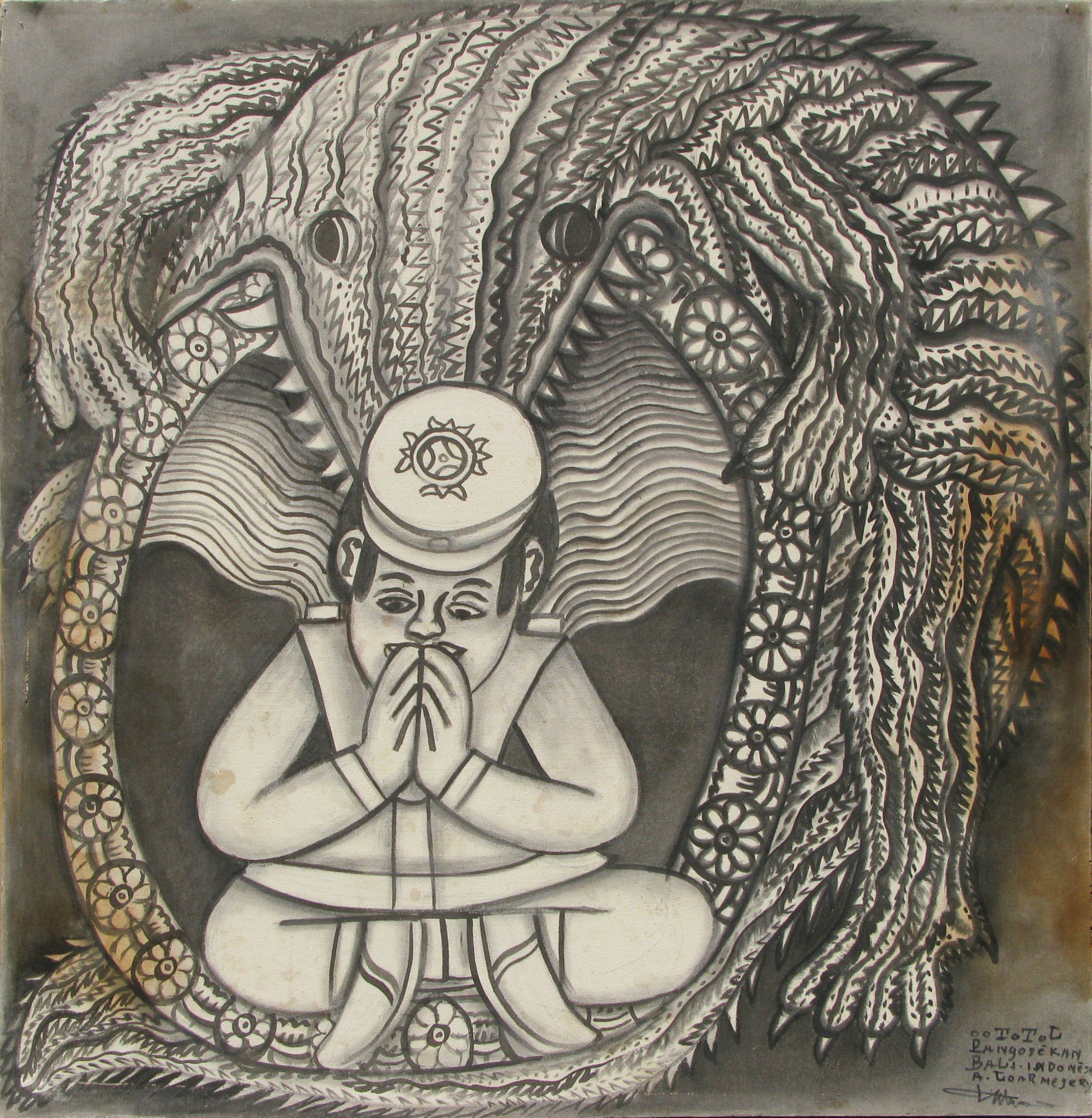

Oototol “Luar Negery” in collaboration with ROH projects
2026.1.31 Sat - 3.1 Sun
Exhibition venue : MISAKO & ROSEN (1F), Fig. (2F)
Opening reception : 2026.1.31 Sat 16:00-18:00
Oototol’s first solo exhibition in Japan, divided between Misako & Rosen and Fig., offers an occasion to examine the formal and narrative play that constituted the late Balinese artist’s production. Working with Chinese ink, bamboo pens, and brushes, Oototol (b. ?–2008) elaborated a pictorial language in which representations of the quotidian and the transgressive are made to occupy a single visual field, raising questions about the conditions under which such conjunctions become legible or permissible.
An artist who left us no written testimonies, much of what is known to us about Oototol has to do with his shared time with a group of Balinese artists, including I Gusti Ayu Kadek Murniasih “Murni”, Dewa Putu Mokoh, and Edmondo “Mondo” Zanolini. Together, their collective exchange left discernible traces across Oototol’s oeuvre through formal affinities. Often framed within these influences, this presentation focuses rather on an engagement with Oototol’s contributions with his singular vision. The exhibitions’ joint title, “Luar Negery”, a misspelled Indonesian phrase meaning “overseas” notated in the corners of many of his paintings, nods to this first series of exhibitions of his work outside Indonesia.
Central to Oototol’s pictorial project is the figure of the soldier, a motif reportedly linked to his interest in Indonesia’s founding president and the military apparatus that underwrote the postcolonial state. In these exhibitions, we encounter soldiers smoking pipes, praying, performing acts of bestiality, lifting weights, riding bulls, consorting with monkeys as friends and lovers. In Oototol’s visual universe, there appears to be nothing a soldier _cannot do_. At Misako & Rosen, this logic finds its formal corollary, where soldiers, in the company of animals and mythological hybrids, are able to compress themselves into uniform square formats, filling the pictorial surface with the pressure of liquids conforming to their containers. And from these forms emerge a sense of fun, horror, and desire, all delivered with zero shame, zero hand-wringing over its own excess.
It is tempting to speak of Oototol’s practice in terms of subversion or critique, of how he seemed to debase a common symbol of power, or else how that same power seems to absorb life into its logic, even in its own mockery. Yet these readings are insufficient to what is genuinely strange and unassimilable about Oototol’s fascination with the soldier in its most uninhibited forms. In a present where such iconography has become inseparable from competing visions of political futurity, it is worth exploring what Oototol was leaving behind that we have not yet been able to process, and what demands his work continue to place on us who seek to understand them today.
ROH